Barcode and Carton Labels for Chair Orders
Published by Foshanchair · Export documentation desk in Foshan, China
A barcode costs a fraction of a cent and can hold up a container. Chair programmes go wrong at the label more often than at the joint, because the label is the one part of the order nobody owns: the buyer assumes the factory knows the numbering, the factory assumes the buyer will send artwork, and the cartons arrive at a distribution centre that scans them once and rejects the pallet. This is how we set up the numbering and marking on a wooden chair programme before the first carton is printed.
1. Four label levels, four different numbers
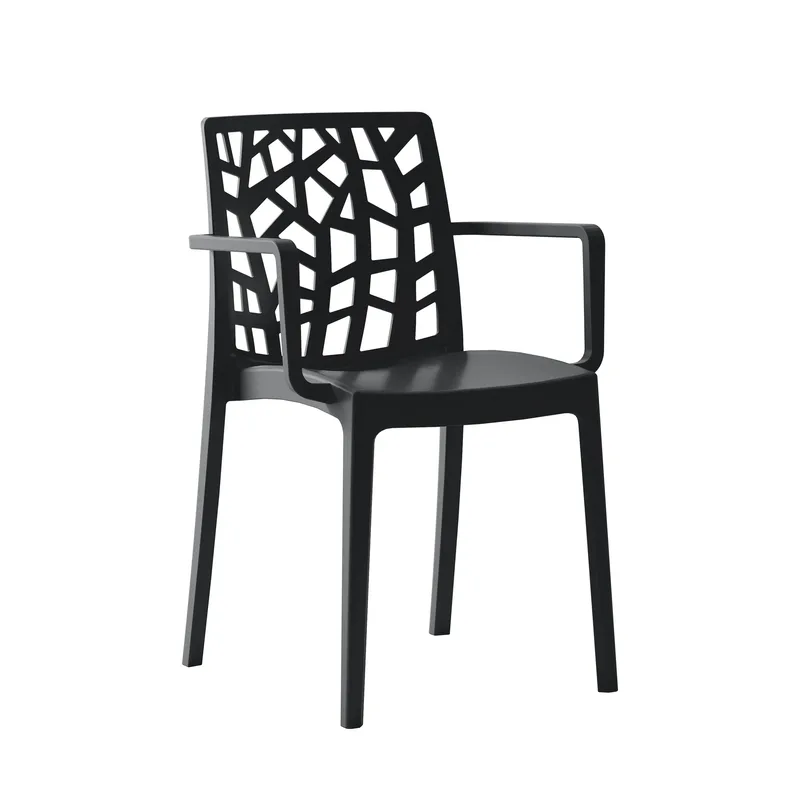
Most confusion comes from treating “the barcode” as one thing: a chair order carries up to four identifiers, each scanned by a different party for a different reason. The retail unit takes a GTIN-13 in an EAN-13 symbol, or a GTIN-12 in UPC-A for North America; that is the number a shop or a website sells. The master carton takes a GTIN-14, normally printed as ITF-14 or inside a GS1-128 symbol, and that number is what the receiving dock scans. The pallet takes an SSCC-18 in GS1-128, which identifies the physical shipment rather than the product. On top of those sits the human-readable mark, which is what people actually read when a scanner fails. A stackable range like our Nordic stackable dining chair can therefore have three item GTINs for three finishes, one carton GTIN per pack configuration, and a fresh SSCC on every pallet shipped.
2. Where the numbers come from, and who owns them
GTINs are licensed, not invented. You join a GS1 member organisation, receive a company prefix, and build each number from that prefix, an item reference you assign yourself and a check digit calculated by the standard. The prefix is licensed to one company: buying a block of numbers from a broker, or inheriting a supplier’s prefix, breaks the rules and shows up quickly when a retailer validates the number against the GS1 registry. Under private label the prefix usually belongs to the retailer, who issues the numbers with the artwork — which is why a private-label programme should never be quoted before the number allocation is confirmed. Keep a GTIN log as a controlled document: model, finish code, cover code, pack quantity, GTIN, date issued, date retired. Our OEM and ODM process starts from that log, not the model photo, because the log is what the retailer’s system matches.
3. What a chair carton actually has to carry
Beyond the barcode, a carton needs enough text for a warehouse clerk with a clipboard: PO number, item code, model name, finish and cover colour, quantity in the pack, gross and net weight, carton dimensions, carton number of total, country of origin and the importer or EU responsible operator’s name and address. Add only the handling pictograms you need — this way up, keep dry, stack limit. Knock-down models need the hardware bag identified by its own part code, because a missing bag stops an assembly line just as effectively as a missing chair. Fire, formaldehyde and timber stamps belong on the components and the pallet, not on the carton label. If the carton also serves a marketplace, the fulfilment label sits over the GTIN and the two systems have to be planned together, as we set out in the e-commerce packaging guide; a cross-back model we build for retail, the stackable cross-back chair, ships in both a wholesale master carton and a single-unit parcel carton.
4. Print quality decides whether it scans
A barcode that looks fine to the eye can grade badly. Direct printing on corrugated is the most durable option and the cheapest at volume, but the board absorbs ink unevenly, so the symbol needs its bearer bars and a quiet zone of at least ten module widths kept clear of print and of the carton edge. Glossy pre-printed labels reflect scanner light; matte film and paper read better. Never place a label across a flap seam or over tape, and never let packing tape cover the symbol. Ask for a verification report to ISO/IEC 15416 at grade C or better on the actual board from the actual printer, then repeat it whenever the board grade, ink or print house changes — a print-house swap mid-programme is the usual cause. Condensation inside a container softens adhesive, so specify a label stock rated for the humidity of a sea freight, not an office printer label. The rest of the carton engineering sits in our export packaging guide for chairs.
5. Routing guides, ASN and the chargeback maths
Large retailers publish a routing guide, and the guide — not your template — governs label position, pallet footprint and height, maximum weight, the SSCC and the advance ship notice that has to arrive before the truck does. Fines are charged per carton or per pallet, so a single wrong label position on a 600-carton order can cost more than the labels and the printer combined. Get the guide version number into the purchase order, convert it into a one-page label drawing with dimensions in millimetres, and require three photographed cartons from the first production run before the line is released. The pallet label is printed at the factory, never at the destination DC, because the SSCC has to travel with the goods. Everything the forwarder will ask for is in our import documents and HS code guide, worth reading next to the label drawing so the numbers agree across invoice, packing list and carton.
6. Change control across colours and reorders
The second order is where labelling usually breaks. A new cover, a new finish, a change from six pieces per carton to four: each is a new trade item and needs a new GTIN, because the old number now describes something the retailer no longer sells. Never recycle a retired number, and never let a factory “use up” the remaining labels from the previous run — that is how two different chairs end up sharing one identity in a warehouse. Put the GTIN, the barcode symbology, the label position, the artwork revision and the print method into the purchase order, approve a marked-up carton with the golden sample, and audit one carton against the drawing at pre-shipment inspection. On flat-pack models the label matrix also has to cover the hardware bag and the assembly sheet, which is the point where numbering and knock-down hardware meet.
Conclusion
Four things belong in the specification: the identifier for each level, the log that shows who owns each number, the carton artwork with its print and position rules, and the change-control clause that forces a new number when the product changes. None of it costs much; all of it is invisible until a distribution centre rejects a pallet and the rework has to be done 8,000 km from the factory. If you are launching a chair range into retail and want the numbering and carton artwork settled before tooling, send us the SKU list and the markets and we will quote the marking with the chairs.
Related: E-Commerce Chair Packaging: Parcel and FBA · Export Packaging for Chairs
Models we build for this
Factory-direct pricing, custom finish and fabric, MOQ from a few pieces.