Commercial Dining Tables: A Buyer's Guide
Published by Foshanchair · Chair and table manufacturing studio in Foshan, China
A restaurant is bought as a seating package: chairs plus tables. Buyers spend weeks comparing chair frames, foam density and stackability, then take whatever table the supplier happens to stock — which is why so many venues end up with tops that look tired after a year and bases that wobble on a busy Friday. A table takes more punishment than a chair: every plate, glass and hot pan lands on it, and it is the surface a guest judges the room by. This guide covers what to specify across the commercial table range, how to size tops against the chairs you have already ordered, and what belongs in the purchase order.
1. The top does the work: solid wood, laminate or stone
Three families cover almost every commercial dining table, and they age in completely different ways. Solid wood — oak, ash, walnut, rubberwood — at 25 to 40 mm thick can be sanded and refinished two or three times, which is what makes a ten-year-old top look new again; a natural oak top on a steel frame is the standard answer for a mid-market dining room. Engineered tops cost less and hold up well in high-turnover sites: high-pressure laminate at 12 mm compact grade, or an 18 to 25 mm substrate faced with HPL or melamine, resists scratches and cleaning chemicals but can only be replaced. Stone and travertine photograph best and chip worst — heavy, sealant-hungry, and noisy under every dropped glass, as you can see in this carved travertine slab top. Read the venue before the catalogue.
2. Edges, thickness and sealing decide how it ages
Two tops can share a species, a footprint and a price and still age completely differently, because the edge is where water gets in. A 25 mm solid top with a slight chamfer reads thinner than it is; a rounded bullnose is kinder to forearms but the finish wears through first at the radius. On engineered tops, ask whether the board is edge-banded or post-formed and insist on a band of at least 2 mm. A 0.4 mm foil lifts after one wet summer, and once water reaches the core the corner swells permanently. Seal the underside as carefully as the top: moisture moves through both faces equally, and an unbalanced finish is the usual reason a board cups. On a walnut-topped cafe table, an oil finish that your own team can spot-repair is worth more than the factory sheen.
3. The base decides wobble, knee room and covers per table
Insurance against wobble lives in the base, not the top, and this is where most cheap tables fail. Four steel or die-cast legs are the cheapest option and the easiest to store, but on an uneven floor you cannot level one leg without shimming it. A pedestal or column base stabilises a small table well — cast iron at roughly 15 to 25 kg under a 700 mm round, and a heavier weight plate under a 1000 mm top — but part of that footprint is knee room you no longer have. Trestle and X-bases suit long communal tables; a stainless steel column suits fold-down and outdoor settings, by the same material logic we set out for stainless steel dining chairs. Whatever you choose, specify adjustable glides on every foot and order a spare set. The same review applies to any commercial restaurant chair going into that room.
4. Sizing: match the top to the chair and the cover
Commercial dining tables stand at 750 mm, with a workable range of about 720 to 760 mm, and bar-height tables run at 1050 to 1100 mm. Against a 450 mm seat height, that leaves roughly 300 mm between seat and tabletop — the clearance that lets a guest cross their legs. Below 250 mm the table starts to feel like a tray. Along the edge, allow 600 mm per cover: a 700 x 700 mm top seats two, 1200 x 700 mm seats four, and 1400 x 800 mm seats four comfortably or six tightly. Depth matters as much as width, because below 700 mm deep, sharing becomes an argument about elbows. Leave 900 to 1000 mm between the table edge and the nearest wall so a chair can be pulled back, and treat all of this as part of a seating quantity plan rather than a decoration decision. If the room includes counter seating, check our bar chair sizing notes before you fix the millwork.
5. Price bands, MOQ and how tables actually ship
In our own range, a walnut-topped square cafe table starts around $65 and a 1400 mm natural oak top on a steel base reaches about $200, with most models at an MOQ of six. Those figures are on each product page rather than hidden behind a quote. Two commercial details move the delivered cost far more than the unit price. First, tops and bases normally ship separately — typically two cartons and 0.35 to 0.6 CBM per table — so confirm carton counts before your forwarder quotes, and check that every box of bases is matched to a box of tops in the same shipment. Second, flat-pack bases cut volume but move assembly to your warehouse, so budget ten to fifteen minutes per table, plus hardware. An outdoor lounge table needs the same carton check as an indoor one, and our export packaging guide explains how to specify the protection.
6. Put the table specification in the purchase order
A table order deserves a written specification for exactly the same reason a chair order does. Write down the species or board construction and thickness; overall dimensions with a tolerance of plus or minus 2 mm; edge profile and band thickness; finish system, sheen, and sealing of both faces; base type, material, finish, static weight and glide; and the load case you expect. EN 15372 covers the strength, durability and stability of non-domestic tables, while the surface-resistance family — EN 12720 for cold liquids, EN 12721 for wet heat, EN 12722 for dry heat — tells you whether a hot plate will leave a ring on the finish. Approve one assembled table and a finish panel before the bulk run, the way our test standards guide recommends for chairs, and state in writing what happens if a top arrives chipped. Custom sizes, edge details and branding all sit inside our OEM development process.
Conclusion
Tables are the half of the room the chairs lean on. Get the top material, the edge, the base and the size right, and the whole order reads as considered rather than assembled from stock. Four things are worth insisting on: an edge band of 2 mm or better on engineered tops, a base heavy enough for the top it carries, 600 mm of width per cover, and 300 mm of clearance between seat and tabletop. If your chairs are already in production and you need tops and bases specified to match — your finish, your dimensions, your quantities — send the covers per table and the destination port through our contact form, and read how we work while you wait. We will quote the set together.
Related: How Many Restaurant Chairs Do You Need? Planning Seats, Spares and Reorders · Export Packaging for Chairs: Cartons, Foam and Drop Tests
Models we build for this
Factory-direct pricing, custom finish and dimensions, MOQ from a few pieces.
 Commercial Dining Tables
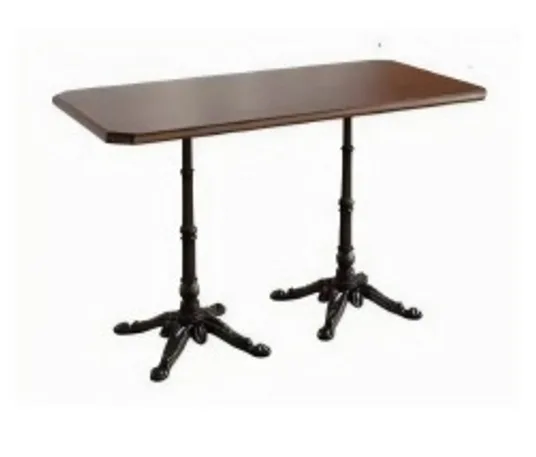
Foshanchair Natural Solid Oak Wood Top Dining Table With Steel Legs
Solid oak top · MOQ 6 pcs · $200
View model →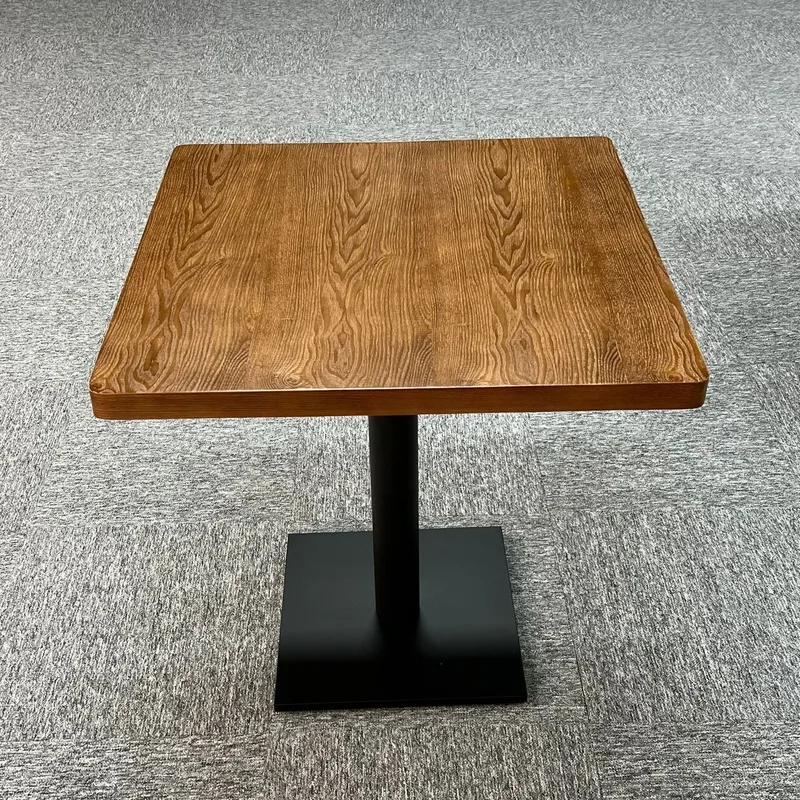 Commercial Dining Tables
Foshanchair Commercial Wooden Cafe Table, Walnut Top
Walnut top · MOQ 2 pcs · $65
View model →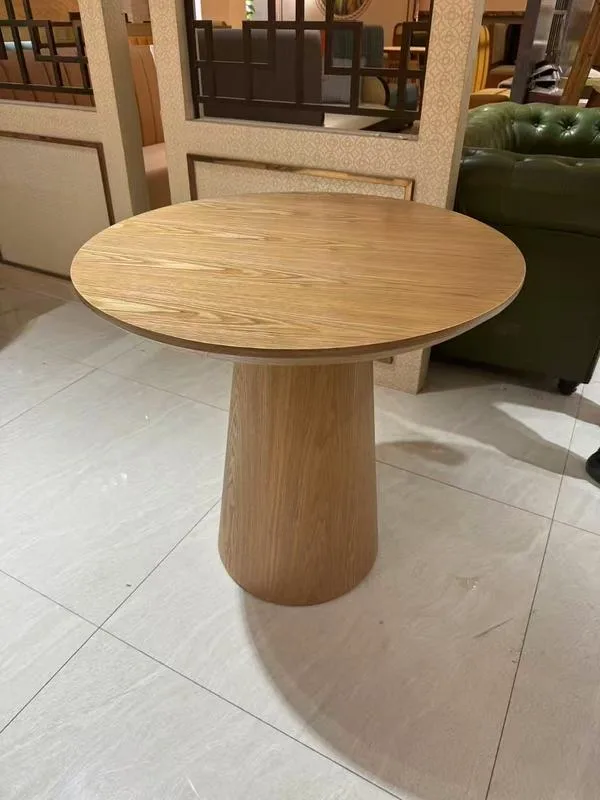 Commercial Dining Tables
Foshanchair Japanese Style Round Slab Dining Table
Solid wood · MOQ 6 pcs · $75
View model →